Posts

Showing posts with the label GCE Lab School

Fantas-tic

Image
What if you had a so-called “normal” life, but there were a few things that challenged your daily routine? In Disease class, we have been learning about various conditions that can alter the way people live and experience life. In the second unit of this term, we have been mainly focusing on mental disorders and the DSM-V - Diagnostic and Statistical Manual of Mental Disorders - Fifth Edition. The DSM-V contains lots of information about many categorized mental disorders. You can find just about any recognized disorder in this large manual. Each student chose a mental disorder to study and present as an action project - I chose Tourette Syndrome. What you are about to read is some basic information about it, what it would be like to have it, a quote from a professional, a social experiment, some math, and a flier. I hope it brings you closer to understanding this unique and complex condition. Meet Gregory McFlutter, he is an 11 year-old boy who is diagnosed with Tourette Syndrome. T...

Not Love at First Sight

Image
Welcome to my first action project for this terms Humanities class, Forbidden Books. This class is about banned and/or censored information, which things like books carry, that some people might not want the public to know about and why. For the first part of the term, we learned about the Socratic Method. The Socratic Method is basically an argument, but with a lot of questions of "why" involved. There are five steps to the Socratic Method. First, look for statements that people would call common sense. Second, find an exception to that rule. Third, if you have proven your statement false, you must go back and ask the question again. Fourth, refine your response. Fifth, continue the process for as long as possible. The Socratic Method can be considered dangerous because it can change how someone thinks, believes, or sees the world around them. This is what got Socrates, the one who invented it, killed for spreading his knowledge onto the children of Athens about there being ...

Breathless

Image
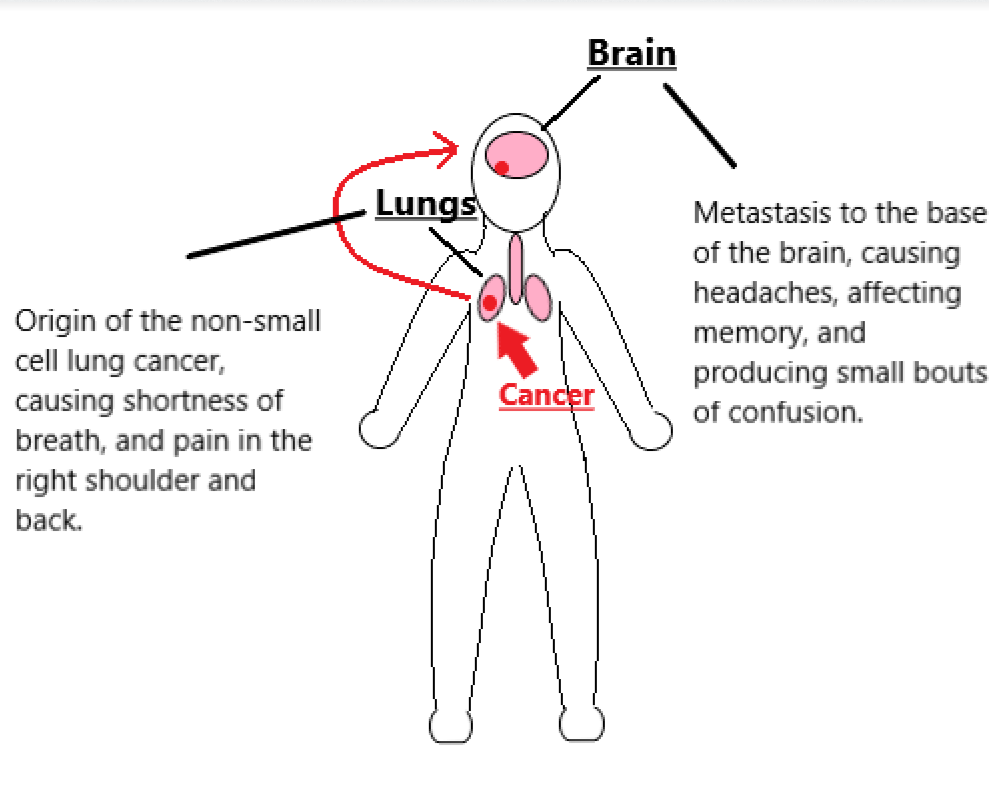
Hello! For the first action project in this term's STEAM class - Disease - we were instructed to choose a disease to research. Each of us studied a patient who has a disease of interest. So far, in this term, we have learned about all of the body systems, diseases, and symptoms. We have learned about a variety of diseases that can be contracted from specific things like genetics or environmental factors. In this action project, I will be talking about a patient who has stage IV non-small cell lung cancer. We will call the patient Mrs. Henn. I will be explaining her process of diagnosis and how she is coping with this condition in her everyday life. In addition, I will be talking about the cancer itself - the anatomy, physiology, etiology, and epidemiology. It is very important to note that Mrs. Henn is still, actively battling this disease. I hope you enjoy! Illustrated by “SN” Meet Mrs. Henn, she has been diagnosed with Stage IV lung cancer. It is a very aggressive and unf...

Boyhood Interrupted

Image
For the final Ollywood AP, I analyzed the film  Stand by Me  by Rob Reiner, released in 1986. It is a boyhood coming-of-age film set in the 1950s. In this class, we have gone through the entire process of film making from start to finish - pre-production, production, and post-production. This analysis includes all of the elements from those three phases of production, such as film editing and cinematography. This AP is in the form of a podcast with an accompanying slideshow and sound clip from the movie. Pardon me if my voice pauses or gets quiet or slow at some points. I hope you enjoy! TRANSCRIPT Hello, I will be critiquing the film Stand by Me - a coming of age drama directed by Rob Reiner that was released on August 8, 1986, starring River Phoenix, Wil Wheaton, Jerry O’Connell, and Corey Feldman as the main characters. This film was based off Stephen King’s novel, The Body. The film is set in the year 1959. It begins with a junior high boy named, Vern Tessio...

Stayin' Alive!

Image
Hello. For this final Game Changers AP, I will be telling you all about Help, We’re Alive!  - a game by SM, BD, and me. In the game, Help, We’re Alive! , one of two players is a group of scientists that are researching an alien life-form on a space station. Another team is a group of hackers who shut down the space station's power that released the alien from its stasis chamber. It is up to both teams to restore the power and get the Keycard to escape the space station before the other team does, without being caught by the alien. This game is recommended for families and friends, ages 12+, who like team building activities. The lesson of the game is that it is better to work through certain situations together than to do them alone. Link to the Rules Here The first draft of  Help We're Alive!  started out having all four players on the same team, and the alien with its own track that it follows. We did not want this game to be the same thing over and over aga...

Simskel and Branbert

Image
Hello! For this second unit of Ollywood, we have been studying the elements of post-production. These elements involve editing, sound, and acting. For this second Action Project, me and my partner, BA, critiqued the movie Lincoln in the style of Siskel and Ebert. Lincoln was a film released in 2012 that was directed by one of the most influential personalities in the history of cinema, Steven Spielberg. He has an extraordinary number of critically acclaimed credits to his name as a director, producer, and writer. If you are looking for a good historical drama film, Lincoln is the movie for you. It has intensity, dramatic lighting, a stellar cast, and wonderful acting. I focused on the lighting and framing, and my partner focused on the acting and costume/set design. We comment on each other's ideas throughout the video, like the late and great movie critics - Siskel and Ebert. Pardon me if I speak a bit slow, it is just something that happens when I am in front of a camera. I hope...

Back to the Elective Term

Image
In the first unit of the Humanities elective term, Ollywood, we have been learning about the elements of pre-production. Pre-production comes before a movie is made. Two important roles in pre-production are the Location Scout and Production Designer. Location Scouts find places where a movie or scenes from a movie can be filmed. We went on a field experience to Lower Wacker Drive where a chase scene from The Dark Knight and Blues Brothers were filmed. We took pictures of places where one could possibly shoot a movie. Production Designers help the setting, background, and characters stand out with props and costumes. For this AP, we were assigned to watch one of a selection of movies and summarize the plot, characters, dialogue, inspiration, stage production, and costume design through our observations. I chose to analyze the 1985 classic - Back to the Future. I hope you enjoy! -------------------- Wdwdbot. (2016) "Back to the Future Logo" Back to the Future begins w...

Preserve the Pachyderms

Welcome to my AP for the third unit of Population. For this AP, I made a video about how human population growth is affecting the chosen organism's population growth. The organism I chose to research was the elephant. The reason why I chose to research elephants is because of their unique behaviors and how their population is quickly decreasing because of humans. You will learn more about what is happening to them in the video below. My math equations appear after the video. They reflect how I got the data for the elephant population on my graph in the video. It is called a geometric sequence - a type of sequence using multiplication and division. Before we get things started, I just want to say that the things we learned in this unit are arithmetic and geometric sequences and symbiotic relationships, which are discussed below. This will be the final AP for my first STEAM class of my sophomore year. I hope you enjoy! Preserve The Pachyderms from S N on Vimeo . This is...

Separate Journeys, Same Fates

Image
Hello, I am SN and I will be talking about two separate heroes and their journeys. One of the two heroes will be fictional. That means that he/she is not real and is from either a book, movie, tv show, video game, etc. The other hero is real and is someone I know and interviewed for this AP. What do these two heroes have in common? Well, they both follow the steps to Joseph Campbell’s monomyth of a hero’s journey. First, heroes have to go through separation from their own world, figuratively or literally. Second, they go through a vast majority of tests of any kind to claim the title of ‘hero’. Third, they have to return to their world after achieving the ultimate boon, symbolically or physically. The fictional hero I chose to analyze is Scott Pilgrim from “Scott Pilgrim vs the World”. One of the main reasons I chose him is because he is an awesome comic book character, and “Scott Pilgrim vs the World” is one of my most favorite movies of all time. However, I also chose him because e...

Writer's Toolbox: Short Story (Egg Stage to Butterfly Stage)

Image
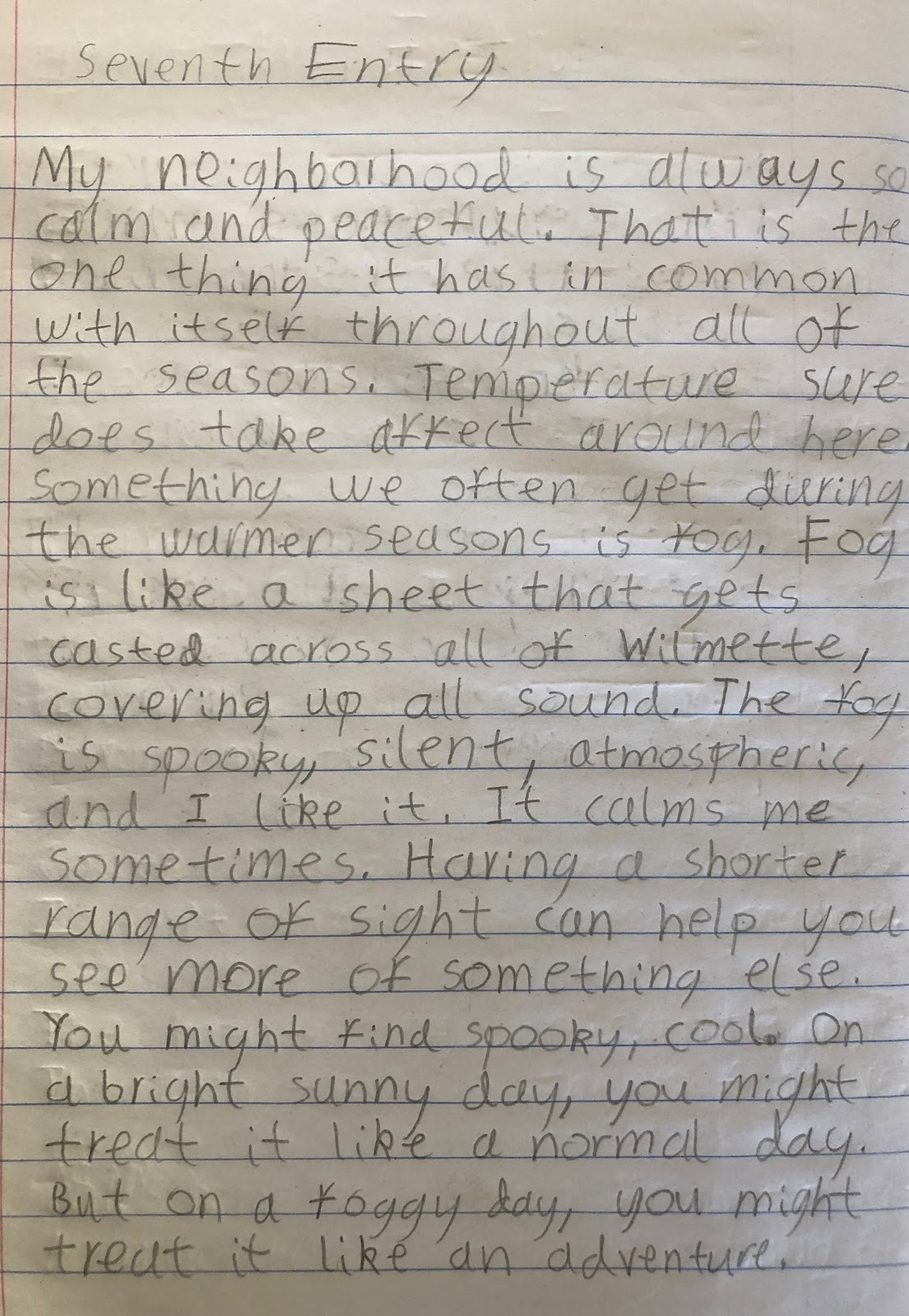
Egg Stage I wrote this piece in my house on a Sunday. It was calm and peaceful, just like all the other times I wrote a journal prompt. Then, I thought of how calm and peaceful my whole neighborhood was. It was around the time when the temperature started to drop this year, which gave me the realization of what my neighborhood had in common with itself throughout all seasons. I have always found my neighborhood to be calm and peaceful, so this is what I chose to write about. I used some descriptive language to help the reader capture the setting and what the surrounding scenery was like. Such as, "Fog is like a sheet that gets cast across all of Wilmette, covering up all sound." What you get from that sentence is that the fog is bigger than my neighborhood, and things are much quieter whenever it arrives. That is the power of descriptive language, you can tell what things are like without it being boring. The main theme of this piece is the fog. It is one thing that c...

Deserted

Image
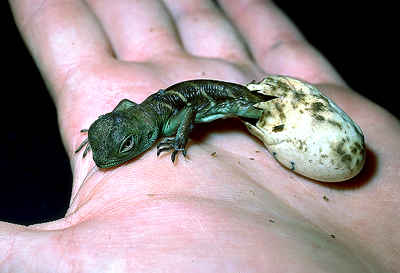
Welcome to my second Action Project blog for Population class. In this unit, we studied how species thrive in their natural habitats and how their special traits allow them to do so. A Field Experience to the Peggy Notebaert Nature Museum taught us about many different landscapes and the animals that live in them. The purpose of this AP was to discover if a certain species or organism could survive in a habitat different from it's own. The species I chose to study was the Chinese Water Dragon, also known by it's scientific name  Physignathus cocincinus. I, hypothetically, altered the Chinese Water Dragon's tropical Asian climate by drying it out. I made inferences about how this change would impact the species and how it would survive in this new climate. ---------------- Chinese Water Dragons are beautiful green lizards reminiscent iguanas, only smaller. They originate from the tropical environments of Asia, but can also be found at nearby pet stores around the...

Fearsome Friends

Image
Welcome to the second Action Project for Stories. For this AP, we were instructed to write a fable. A fable consists of a protagonist, antagonist, symbol, and lesson to teach the reader. The underlying lesson is one of the main identifying factors of a fable. Also, all of the characters in fables are animal-based. Animals help the reader to understand the traits of each character. The protagonist of this story is a mouse named Remey. He has nightmares and is afraid of anything bigger and stronger than he is. The antagonists of the story are his fears getting in the way of him making new friends. The lesson and symbols of the story are something you are going to find out yourselves - they are things with deeper meanings that I do not want to spoil for you. Do not worry! This story will be easy to understand. I really enjoyed making it, so hope you enjoy reading it.  Illustrated by "SN" Once upon a time, there was a mouse named Remey. Remey had a hard time making frie...

Welcome to My World

Image
Welcome to my first Action Project for the class Stories. In this class, we learned the term "etiology" and what it means. Etiology is the story of how something came to be - like mankind, for example. We have been reading a lot of mythological stories on how things came to be. For this Action Project, we were instructed to create our own stories about the etiology of how something came to be. It didn't have to be real. In this Action Project, we can make up our own world. When I made this action project, I put in too many words. I struggled all night taking out words while trying to keep this story good. I did well creating the it though. I am good at setting my imagination free. If I were to re-write this story, I would have focused less on introducing all of the characters. That is probably one of the reasons why I had too many words. Anyways, we all learn from our mistakes. I hope you enjoy! "Ancient Cave Painting of  Man and Chimera Together" Illustra...

Universal Set = {Fennec Fox}

Image
Hello; I am SN. This is my first blog post for my Sophomore year. I am taking a class called Population. It has been incredibly fun and interesting. So far, we have learned about set theory, binomial nomenclature, taxonomy, and have read the book In the Shadow of Man by Jane Goodall over the summer. I am going to cover most of that in this AP (Action Project). For this Action Project, we had to choose an organism, identify its population, and highlight what makes the population unique. During our first FE (Field Experience), our STEAM teacher had us choose an organism at Lincoln Park Zoo. For this AP, I have chosen the fennec fox, a.k.a Vulpes zerda. You might ask, "What is a fennec fox? I will show you in this AP, along with everything else we studied thus far. The fennec fox is a small mammal that is from the Sahara of North Africa. It, naturally, lives in very hot and sandy climates. That would make sense because, according to the Lincoln Park Zoo website, it is said the fennec...