Posts

Showing posts with the label STEAM

Fantas-tic

Image
What if you had a so-called “normal” life, but there were a few things that challenged your daily routine? In Disease class, we have been learning about various conditions that can alter the way people live and experience life. In the second unit of this term, we have been mainly focusing on mental disorders and the DSM-V - Diagnostic and Statistical Manual of Mental Disorders - Fifth Edition. The DSM-V contains lots of information about many categorized mental disorders. You can find just about any recognized disorder in this large manual. Each student chose a mental disorder to study and present as an action project - I chose Tourette Syndrome. What you are about to read is some basic information about it, what it would be like to have it, a quote from a professional, a social experiment, some math, and a flier. I hope it brings you closer to understanding this unique and complex condition. Meet Gregory McFlutter, he is an 11 year-old boy who is diagnosed with Tourette Syndrome. T...
Breathless

Image
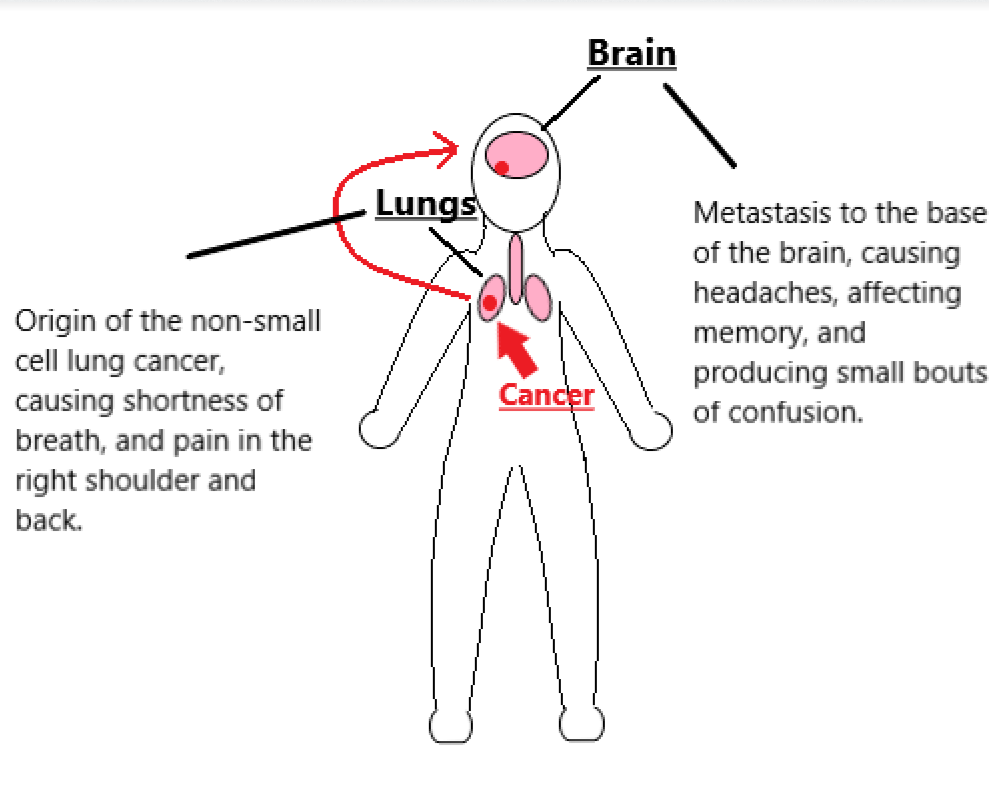
Hello! For the first action project in this term's STEAM class - Disease - we were instructed to choose a disease to research. Each of us studied a patient who has a disease of interest. So far, in this term, we have learned about all of the body systems, diseases, and symptoms. We have learned about a variety of diseases that can be contracted from specific things like genetics or environmental factors. In this action project, I will be talking about a patient who has stage IV non-small cell lung cancer. We will call the patient Mrs. Henn. I will be explaining her process of diagnosis and how she is coping with this condition in her everyday life. In addition, I will be talking about the cancer itself - the anatomy, physiology, etiology, and epidemiology. It is very important to note that Mrs. Henn is still, actively battling this disease. I hope you enjoy! Illustrated by “SN” Meet Mrs. Henn, she has been diagnosed with Stage IV lung cancer. It is a very aggressive and unf...

Stayin' Alive!

Image
Hello. For this final Game Changers AP, I will be telling you all about Help, We’re Alive!  - a game by SM, BD, and me. In the game, Help, We’re Alive! , one of two players is a group of scientists that are researching an alien life-form on a space station. Another team is a group of hackers who shut down the space station's power that released the alien from its stasis chamber. It is up to both teams to restore the power and get the Keycard to escape the space station before the other team does, without being caught by the alien. This game is recommended for families and friends, ages 12+, who like team building activities. The lesson of the game is that it is better to work through certain situations together than to do them alone. Link to the Rules Here The first draft of  Help We're Alive!  started out having all four players on the same team, and the alien with its own track that it follows. We did not want this game to be the same thing over and over aga...

Preserve the Pachyderms

Welcome to my AP for the third unit of Population. For this AP, I made a video about how human population growth is affecting the chosen organism's population growth. The organism I chose to research was the elephant. The reason why I chose to research elephants is because of their unique behaviors and how their population is quickly decreasing because of humans. You will learn more about what is happening to them in the video below. My math equations appear after the video. They reflect how I got the data for the elephant population on my graph in the video. It is called a geometric sequence - a type of sequence using multiplication and division. Before we get things started, I just want to say that the things we learned in this unit are arithmetic and geometric sequences and symbiotic relationships, which are discussed below. This will be the final AP for my first STEAM class of my sophomore year. I hope you enjoy! Preserve The Pachyderms from S N on Vimeo . This is...

Deserted

Image
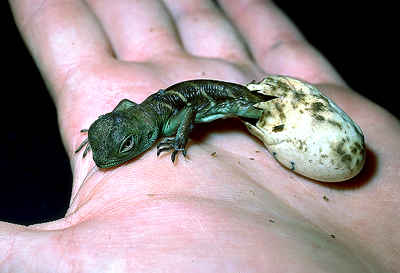
Welcome to my second Action Project blog for Population class. In this unit, we studied how species thrive in their natural habitats and how their special traits allow them to do so. A Field Experience to the Peggy Notebaert Nature Museum taught us about many different landscapes and the animals that live in them. The purpose of this AP was to discover if a certain species or organism could survive in a habitat different from it's own. The species I chose to study was the Chinese Water Dragon, also known by it's scientific name  Physignathus cocincinus. I, hypothetically, altered the Chinese Water Dragon's tropical Asian climate by drying it out. I made inferences about how this change would impact the species and how it would survive in this new climate. ---------------- Chinese Water Dragons are beautiful green lizards reminiscent iguanas, only smaller. They originate from the tropical environments of Asia, but can also be found at nearby pet stores around the...

Universal Set = {Fennec Fox}

Image
Hello; I am SN. This is my first blog post for my Sophomore year. I am taking a class called Population. It has been incredibly fun and interesting. So far, we have learned about set theory, binomial nomenclature, taxonomy, and have read the book In the Shadow of Man by Jane Goodall over the summer. I am going to cover most of that in this AP (Action Project). For this Action Project, we had to choose an organism, identify its population, and highlight what makes the population unique. During our first FE (Field Experience), our STEAM teacher had us choose an organism at Lincoln Park Zoo. For this AP, I have chosen the fennec fox, a.k.a Vulpes zerda. You might ask, "What is a fennec fox? I will show you in this AP, along with everything else we studied thus far. The fennec fox is a small mammal that is from the Sahara of North Africa. It, naturally, lives in very hot and sandy climates. That would make sense because, according to the Lincoln Park Zoo website, it is said the fennec...

OMG! GMOs!

Image
You may have heard the acronym ‘GMOs’ thrown around before, but do you know what it means? GMO stands for Genetically Modified Organisms. A GMO is a plant, animal, microorganism or other organism whose genetic makeup has been modified using genetic engineering . This process creates combinations of plant, animal, bacterial and viral genes that do not occur in nature. Over the past few years, there have been several debates about the safety of Genetically Modified crops (GM crops). Some groups argue that GM crops are an important contribution to the world’s growing population. Other groups are concerned that GM crops degrade the health of humans, animals, and the planet. In this FOOD unit, the class studied both sides of the GM crop argument and had to choose a side for themselves - anti-GMO or pro-GMO. I am in the anti-GMO camp, and I would like to tell you why. You should know that someone has been messing with your food. Many of the products consumed on a daily ...

The Climate of Crops

Image
INTRODUCTION In the second unit of Food For Thought (Death), we learned about things that have and can lead to the decline of crops. For example, the Irish Potato Famine was caused by a fungal potato infection that wiped out the entire crop. The reason the potato crop had little chance of surviving was because it was a monoculture - a prolonged crop of one specific species of plant. For this action project, I was given a choice of a threat to write about that could affect our global food system. I chose to write about climate change, which, unfortunately, has become a source of many problems across several subjects. Not just from the present, but from the past, as well. Over the course of history, climate change has affected crops. Learn how, over time, natural disasters, such as droughts, rising air temperatures, and flooding, have ruined the agriculture of food. —————— Look out…your food has stopped growing. Cherry trees have been suffering from blooming either too early or ...

Rise & Shine

Image
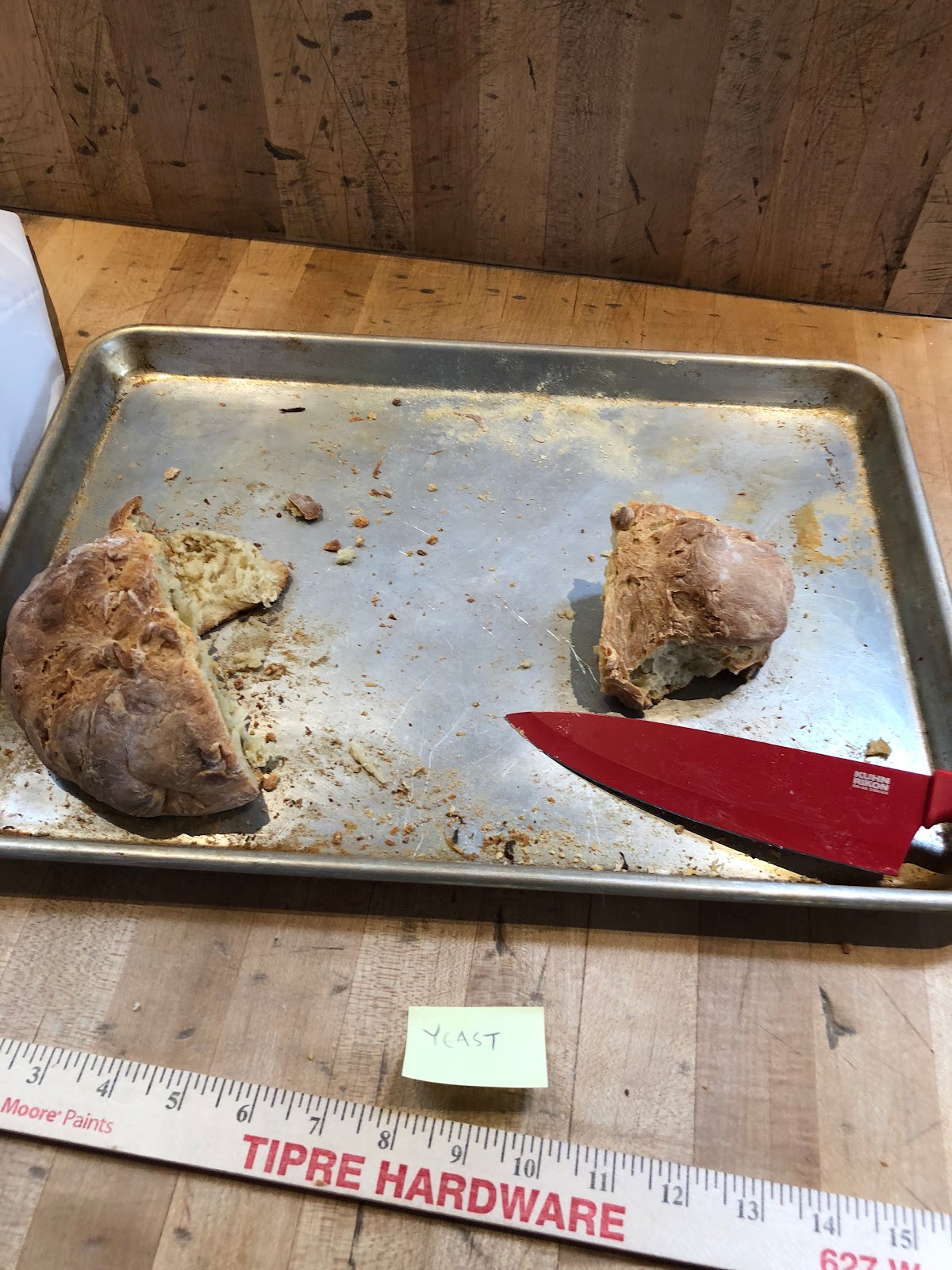
What makes dough rise? When you combine ingredients to make bread, the dough appears to, magically, double in size! How does this happen? Separated, these ingredients aren't very exciting. When combined (with the addition of heat), they transform to create a soft, fluffy, delicious loaf of bread. Yum! According to the Law of Conservation of Mass,  matter can be neither created nor destroyed. In other words, the mass of an object or, in this case, the collection of objects, never changes, no matter how the parts are rearranged ("Conservation of Mass"). Chemical reactions take place and transform the ingredients. In a bread recipe, the active ingredient is the leavening  agent. The leavening agent is what makes your dough expand and 'rise'. In our FOOD course, we have been learning about the science of food. I never really thought of food as science before, but it is. Think about it...growing food is Biology, and cooking food is Chemistry. The main focus of thi...